Charged Aerosol Detector (CAD)
Application Brief
Direct non-derivatized analysis of 17 amino acids




 Instrumax (Tianjin) Co., Ltd.
Direct non-derivatized analysis of 17 amino acids
Instrumax (Tianjin) Co., Ltd.Amino acid analysis is one of the most important techniques in life-science research. Amino acids are the basic building blocks of proteins; except for a few aromatic amino acids, most amino acids have weak UV absorption. Direct UV detection therefore often suffers from low sensitivity and strong interference.
In peptide-drug research, Amino Acid Composition Analysis (AACA) is a core step. It supports sequence verification and, when combined with mass spectrometry (MS) and chromatographic techniques such as HPLC-CAD, helps characterize complex peptides, including peptides containing unnatural amino acids or post-translational modifications.
This application uses reversed-phase HPLC with the Instrumax Charged Aerosol Detector (CAD), model CADetector a1, to directly determine 17 amino acids without derivatization. The method is fast, simple, accurate, sensitive, repeatable and linear.
Instrumax (Tianjin) Co., Ltd.Instrument: Agilent 1200 liquid chromatograph.
Detector: Instrumax CADetector a1 Charged Aerosol Detector (CAD).
Reagents: purified water (Watson distilled water), acetonitrile (chromatography grade), trifluoroacetic acid (analytical grade), and heptafluorobutyric acid (analytical grade).
Sample: certified 17-amino-acid mixed standard solution in hydrochloric acid.
Column: ZORBAX SB-C18, 3.5 μm, 4.6 × 250 mm. Flow rate: 0.8 mL/min.
Mobile phase A: water containing 0.7% trifluoroacetic acid and 5 mmol/L heptafluorobutyric acid. Mobile phase B: acetonitrile. Diluent: water.
CAD conditions: CADetector a1; drift tube temperature 35 °C; atomizing gas flow 3 L/min; corona gas flow 1 L/min; corona current 1 μA; gain 0.05; RF 2.0.
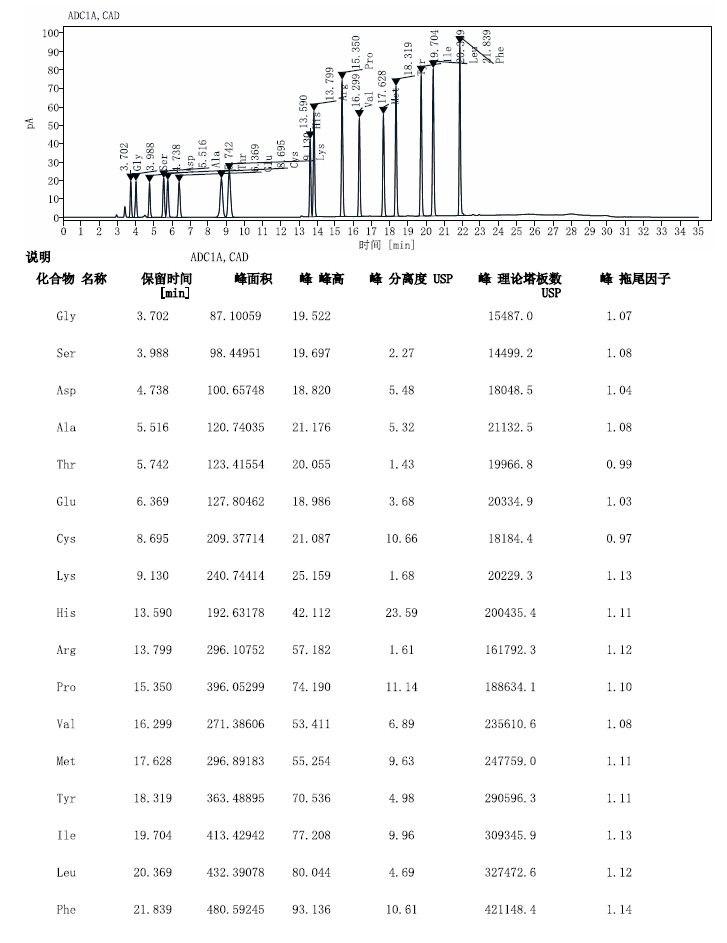
Instrumax (Tianjin) Co., Ltd.Under these conditions, the 17 amino acids were well separated. Adjacent components were effectively resolved, the peaks were sharp, and column efficiency was high.
 Instrumax (Tianjin) Co., Ltd.
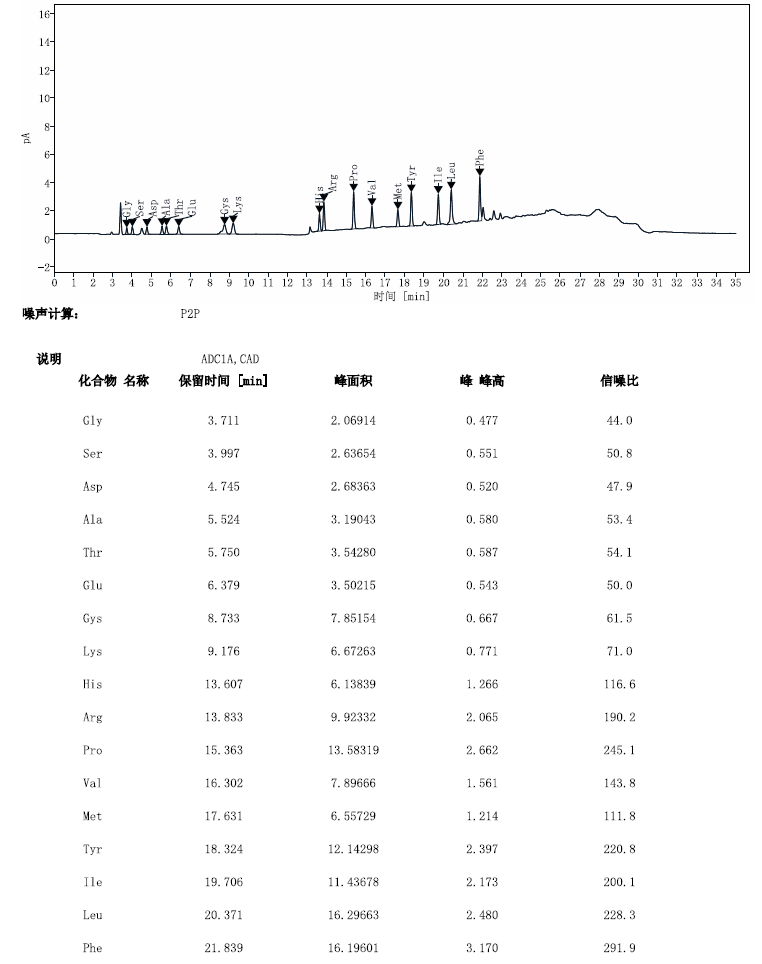
The 100 pmol amino-acid sample showed a good signal-to-noise ratio, calculated automatically by the software using the P2P method.
 Instrumax (Tianjin) Co., Ltd.
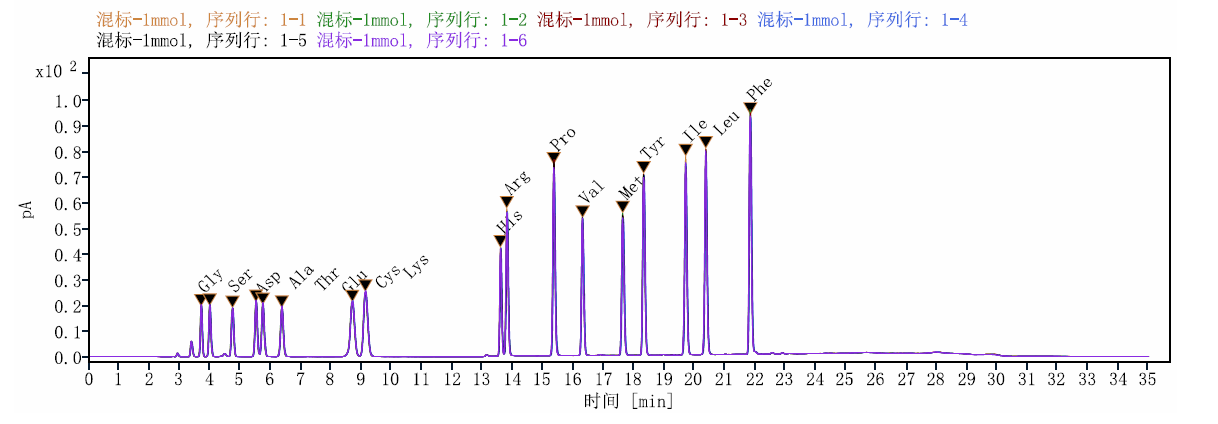
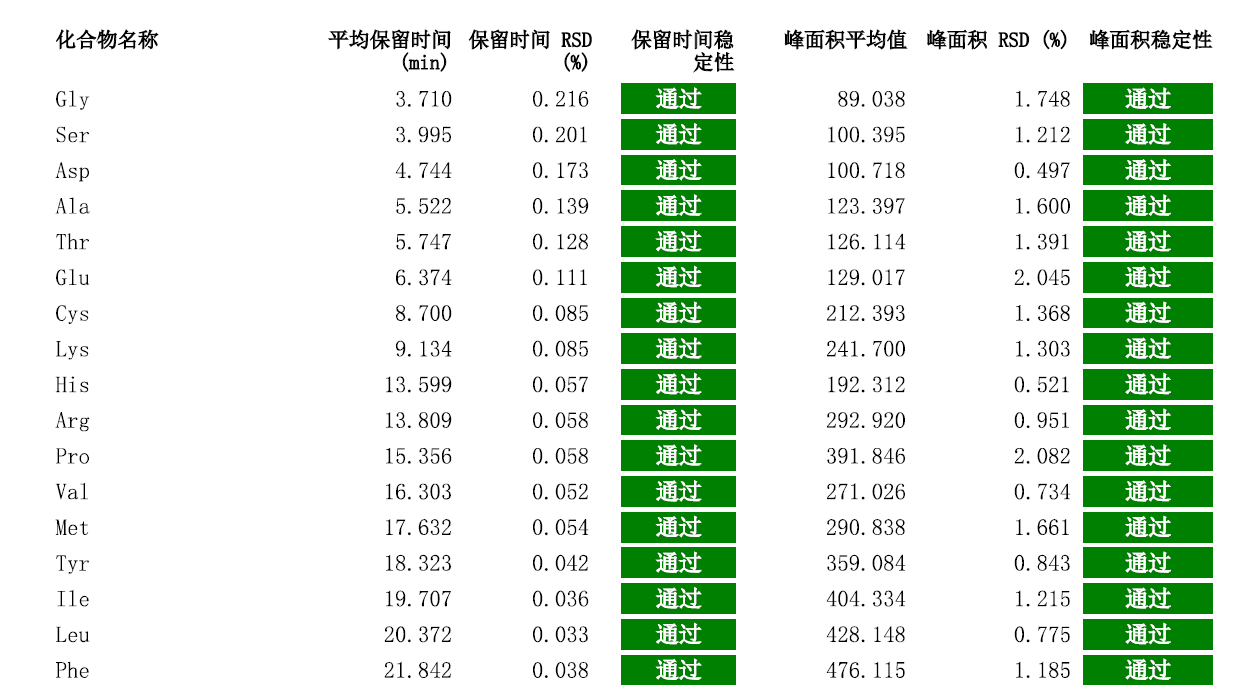
A 1 mmol/L standard solution was injected at 5 μL for six consecutive injections. The RSD% values for all amino acids were good.
Injection volumes of 1 μL, 2 μL, 5 μL, 10 μL and 20 μL were used. Linear equations were calculated from injection volume and peak area. Linearity was excellent, and all component correlation coefficients were greater than 0.999.
 Instrumax (Tianjin) Co., Ltd.
| No. | Component | Linear equation | Correlation coefficient R |
|---|---|---|---|
| 1 | Glycine (Gly) | y=18.4029x-2.4676 | 0.99997 |
| 2 | Serine (Ser) | y=20.6894x-2.1976 | 0.99997 |
| 3 | Aspartic acid (Asp) | y=19.6119x+0.7603 | 0.99992 |
| 4 | Alanine (Ala) | y=23.0974x+4.0342 | 0.99963 |
| 5 | Threonine (Thr) | y=24.4949x+3.2034 | 0.99963 |
| 6 | Glutamic acid (Glu) | y=24.7983x+3.3148 | 0.99963 |
| 7 | Cystine (Cys) | y=40.0386x+6.0799 | 0.99968 |
| 8 | Lysine (Lys) | y=45.3407x+9.2496 | 0.99967 |
| 9 | Histidine (His) | y=34.6789x+11.3921 | 0.99942 |
| 10 | Arginine (Arg) | y=55.8643x+6.4591 | 0.99996 |
| 11 | Proline (Pro) | y=70.7237x+20.7902 | 0.99945 |
| 12 | Valine (Val) | y=51.4909x+7.5024 | 0.99964 |
| 13 | Methionine (Met) | y=58.4620x-13.7992 | 0.99981 |
| 14 | Tyrosine (Tyr) | y=64.1751x+25.8099 | 0.99912 |
| 15 | Isoleucine (Ile) | y=76.4371x+13.1955 | 0.99978 |
| 16 | Leucine (Leu) | y=81.4997x+14.6637 | 0.99975 |
| 17 | Phenylalanine (Phe) | y=89.0247x+22.3171 | 0.99951 |
This HPLC-CAD method determines amino acids directly without derivatization. It eliminates complicated pretreatment, avoids errors caused by derivatization conditions or reagents, simplifies operation, and provides accurate and reliable results for amino-acid determination and peptide-drug research.