Mono-tert-butyl Eicosanedioate
CAD Detector Test Report




 Instrumax (Tianjin) Co., Ltd.Instrumax (Tianjin) Co., Ltd.
Mono-tert-butyl eicosanedioate (CAS 683239-16-9) is a non-cleavable ADC linker used for antibody-drug conjugates (ADC). It is also an alkyl-chain PROTAC linker that can be used in PROTAC synthesis.
Mono-tert-butyl eicosanedioate (20-(tert-butoxy)-20-oxoicosanoic acid) is a long-chain dicarboxylic-acid derivative with acidic properties. It can be synthesized through esterification and is mainly used as an organic-synthesis intermediate. This compound is important in pharmaceutical synthesis, especially for biologically active molecules, such as insulin derivatives for diabetes and obesity research.
During preparation of mono-tert-butyl eicosanedioate, the target compound and related substances show weak UV absorption. Therefore, the charged aerosol detector (CAD) can be used as an efficient detection method for monitoring reaction progress and evaluating product purity. HPLC-CAD detects intermediates and final products in the synthesis process, helping ensure high selectivity, high yield and reliable quality control.
Instrument: Hitachi Primaide PLUS liquid chromatograph
CAD detector (Instrumax, model: CADetector a1)
Tandem detector configuration: UV detector first, followed by CAD detector.
Reagents: purified water (Watson distilled water), acetonitrile (chromatography grade), trifluoroacetic acid (analytical grade)
Samples: mono-tert-butyl eicosanedioate crude products (2 batches)
Column: C18 column, 250 × 4.6 mm, 5 μm
Column temperature: 45 °C
Flow rate: 1 mL/min
Instrumax (Tianjin) Co., Ltd.Injection volume: 2 μL and 20 μL
Mobile phase A: 0.1% TFA aqueous solution; mobile phase B: acetonitrile
Gradient conditions:
Time (min) | A | B |
0 | 30 | 70 |
20 | 5 | 95 |
45 | 5 | 90 |
46 | 30 | 70 |
55 | 30 | 70 |
UV detector condition: 214 nm
CAD detector conditions:
Instrument model: Instrumax CADetector a1
Drift tube temperature: 40 °C
Atomizing gas flow: 3 L/min
Charging current: 1 μA
Charging gas flow: 1 L/min
Gain: 0.05
Diluent: methanol
Sample 1: weigh about 30 mg into a 10 mL volumetric flask, dissolve and dilute to volume with methanol; sample concentration about 3 mg/mL.
Sample 2: weigh about 100 mg into a 10 mL volumetric flask, dissolve and dilute to volume with methanol; sample concentration about 10 mg/mL.
Instrumax (Tianjin) Co., Ltd.Result: concentration 3 mg/mL, injection volume 2 μL.
CAD detector: the main peak is not flat-topped, and impurity detection is normal.
UV detector: the main peak is small, and impurities cannot be detected.
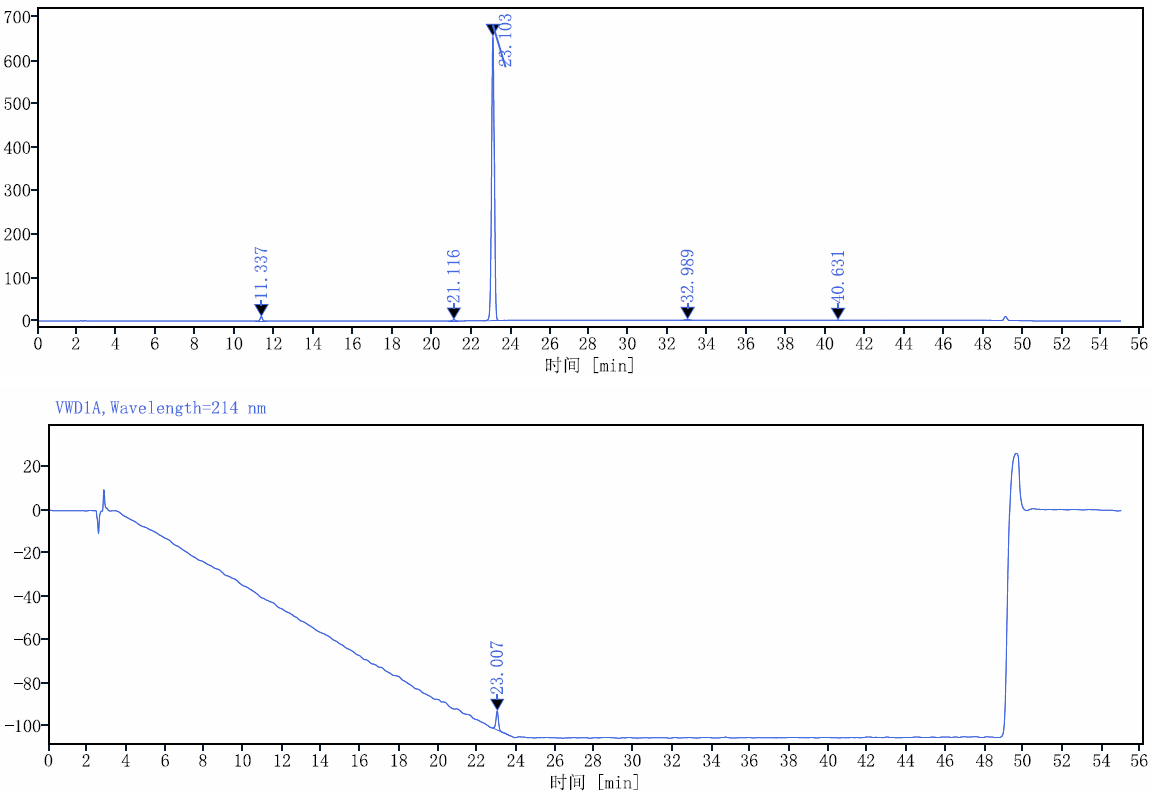
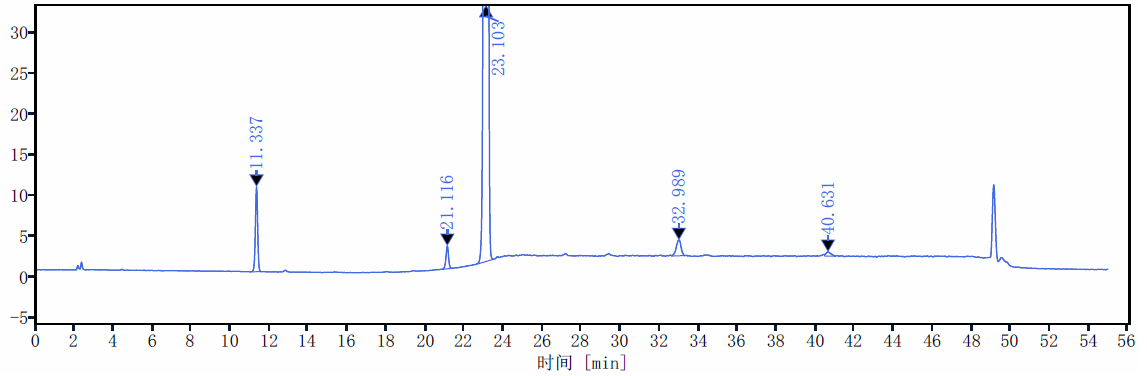 Instrumax (Tianjin) Co., Ltd.
Result: concentration 10 mg/mL, injection volume 20 μL.
CAD detector: the main peak is flat-topped, and impurity detection is normal.
UV detector: the main peak is small, and impurities cannot be detected.
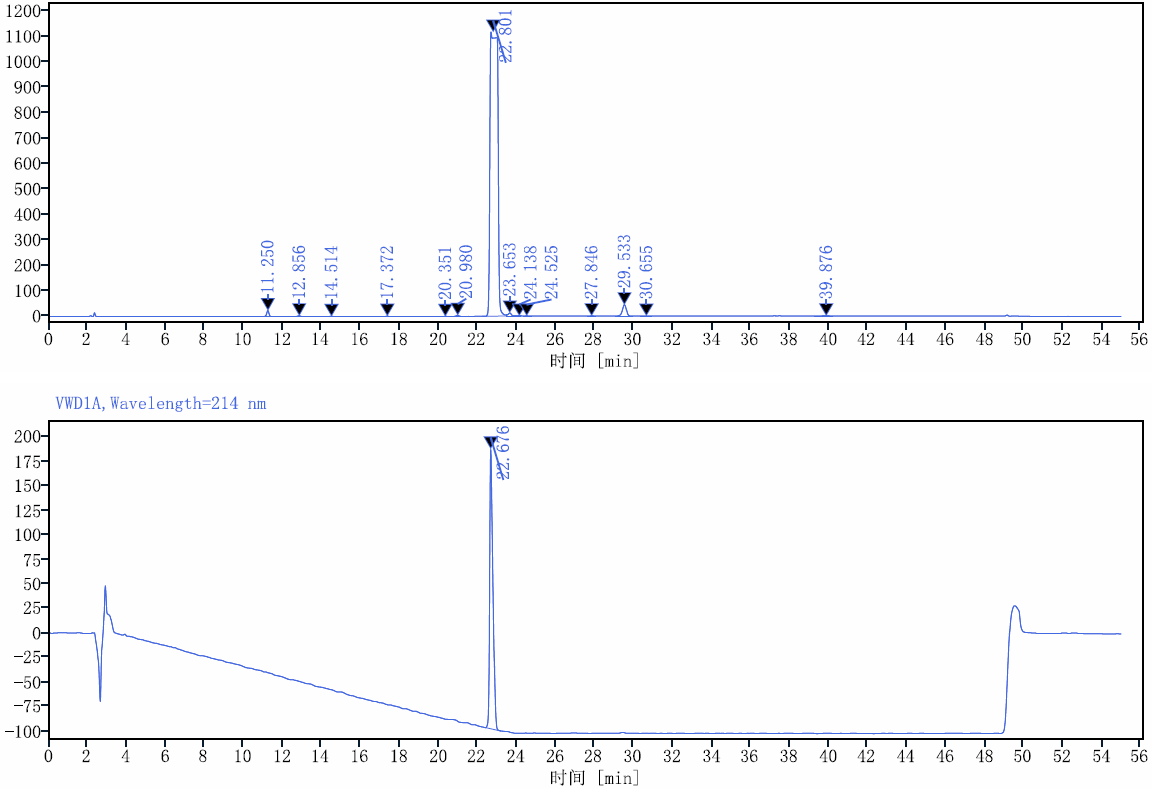
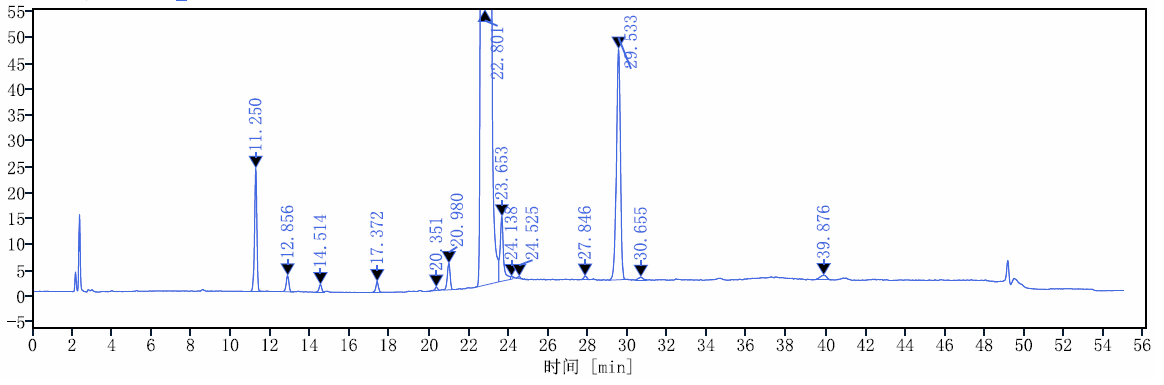 Instrumax (Tianjin) Co., Ltd.
The results show that the charged aerosol detector (CAD) provides good response for mono-tert-butyl eicosanedioate and related substances. Compared with the UV detector, CAD offers a clear detection advantage.