Charged Aerosol Detector (CAD) Application Brief:
D-Allulose Detection




 Instrumax (Tianjin) Co., Ltd.Instrumax (Tianjin) Co., Ltd.
D-allulose, also known as allulose, occurs naturally in small amounts in figs and other foods. Its sweetness is about 70% that of sucrose, but after ingestion most of it is eliminated from the body within about 6 hours. It hardly participates in human metabolism and contributes extremely low calories. Its clean sweetness and mouthfeel are very similar to sucrose. It is also considered a functional ingredient with potential health benefits.
Animal and human studies have shown that D-allulose can inhibit intestinal glucose absorption and improve insulin sensitivity, thereby reducing postprandial blood-glucose spikes. It may also help regulate lipid metabolism, reduce lipid content in plasma and liver, and lower fat accumulation, giving it potential value in weight-management research. D-allulose also shows certain antioxidant and anti-inflammatory properties.
Charged Aerosol Detector (CAD) is a universal detector developed in recent years. CAD response is largely independent of the molecular structure of the analyte, and the analyte does not need to be ionized. Semi-volatile and non-volatile compounds can be detected by CAD. At the same time, CAD is a mass-sensitive detector: for the same analyte mass, the measured response is generally consistent, enabling low detection limits and high sensitivity.
The CADetector a1 charged aerosol detector is an important achievement of the INSTRUMAX R&D team after years of research and repeated experiments. It uses advanced aerosol charging and atomization technologies to support high-sensitivity, high-precision trace analysis.
This application investigates a D-allulose detection method using CAD, showing high sensitivity and good linearity. It provides a new high-sensitivity method for D-allulose analysis and supports improved quality control for related products.
Instrumax (Tianjin) Co., Ltd.Instrument: Agilent 1200 liquid chromatograph
Charged Aerosol Detector (CAD) (INSTRUMAX, model: CADetector a1)
Reagent: purified water (Watson’s distilled water)
Sample: D-allulose
Mobile phase: purified water
Column: sugar-analysis column, 300 mm × 7.8 mm, 8 μm
Column temperature: 80 °C
Flow rate: 0.6 mL/min
Drift tube temperature: 35 °C
Atomizing gas flow: 3 L/min
Charging gas flow: 1 L/min
Charging current: 1 μA
Gain: 0.05
RF: 2.0
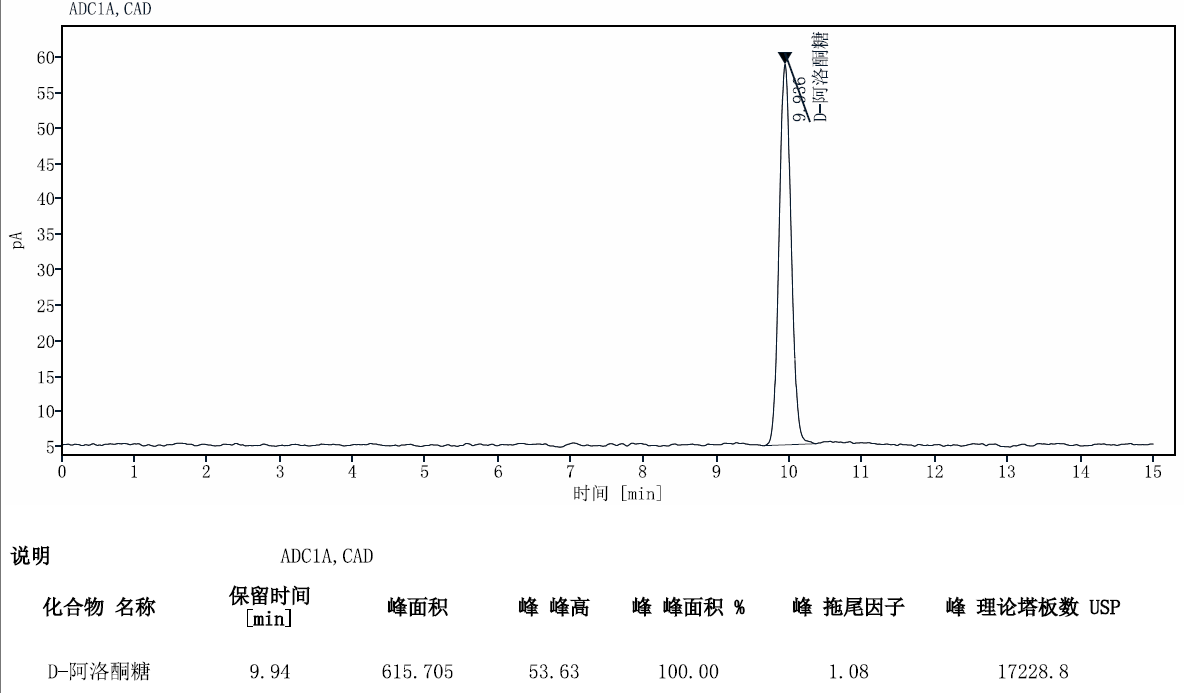
Instrumax (Tianjin) Co., Ltd.For a 20 μg/mL sample with a 10 μL injection volume, the retention time is appropriate, the peak shape is good, the tailing factor is only 1.08, and the theoretical plate number reaches 17,228.
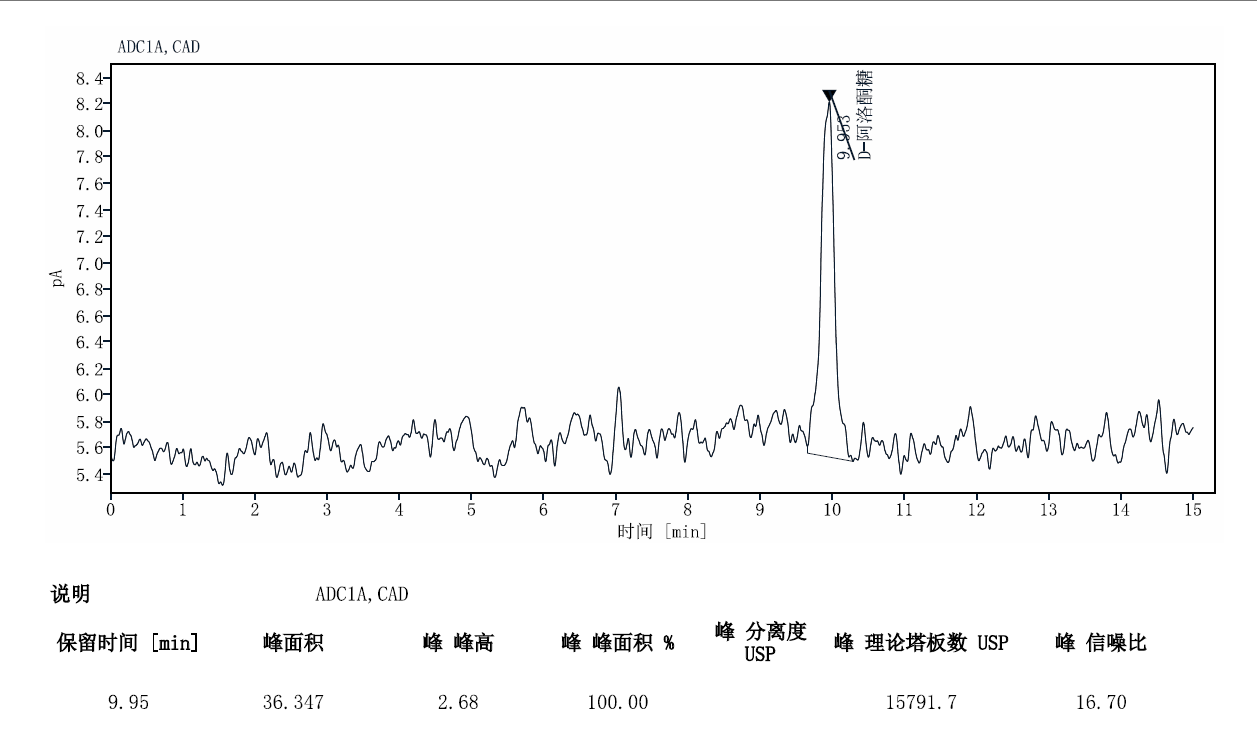
For a 5 μg/mL sample with a 10 μL injection volume, the signal-to-noise ratio reaches 16.70. Compared with a refractive index (RI) detector, whose minimum detectable concentration is 500 μg/mL, the detectable concentration is greatly reduced and sensitivity is significantly improved.
 Instrumax (Tianjin) Co., Ltd.
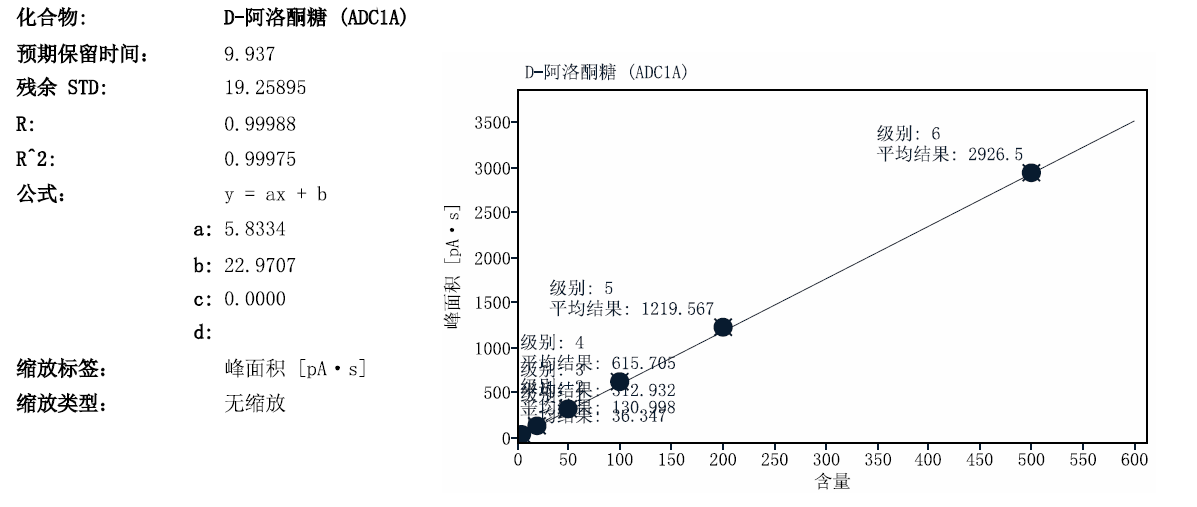
Samples at 5, 20, 50, 100, 200 and 500 μg/mL were each injected at 10 μL. A calibration equation was built using sample concentration and peak area.
The method shows good linearity: the correlation coefficient R for D-allulose is 0.99988.
This study uses HPLC-CAD to determine D-allulose. The method shows good peak shape, high sensitivity and good linearity. CAD is simple to operate and provides accurate, reliable results, offering strong instrument and method support for D-allulose determination and related product analysis.