Atomization
A two-phase coaxial nebulizer uses a high-speed gas flowto impact the mobile phase, with an average particle size of ≤10 µm.





The Charged Aerosol Detector (CAD) is a universal detector with high sensitivity, high reproducibility, and a wide linear range for non-volatile and semi-volatile compounds.
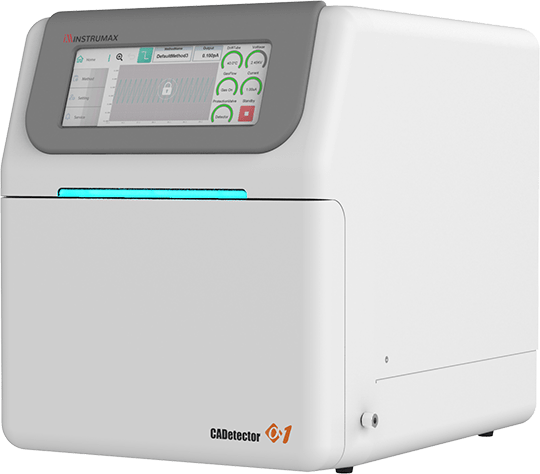


A two-phase coaxial nebulizer uses a high-speed gas flowto impact the mobile phase, with an average particle size of ≤10 µm.
A stainless-steel evaporation tube and high-precision temperature sensorprovide temperature-control accuracy of ±0.01 °C.

A tungsten-alloy corona needle and high-voltage corona technologyprovide corona-current accuracy of ±0.1 nA.

A Faraday cup with gas filtration captures charged particleswith charge-collection accuracy of ±0.5 fA.


Excellent response for compounds down to the pg level.

Repeatability below 2% RSD supports reliable and accurate results.

A linear range spanning four orders of magnitude.

Suitable for non-volatile and semi-volatile compounds.

Mass-sensitive detection more closely reflects the actual analyte mass.
| Detector type | CAD | ELSD | UVD | RID | MS |
| Sensitivity | ✅ | ✅ | ✅ | ||
| Gradient compatibility | ✅ | ✅ | ✅ | ✅ | |
| Baseline stability | ✅ | ✅ | ✅ | ||
| Solvent influence | ✅ | ✅ | ✅ | ||
| Mass response consistency | ✅ | ✅ | ✅ |

Supports drug discovery, development, pharmacokinetic studies, clinical trials, and pharmaceutical QA/QC.

Supports separation and analysis of raw materials and products in petrochemical production.

Addresses increasing quality and safety requirements in food analysis.

Supports analytical needs arising from semiconductor research and manufacturing.

Supports pollution monitoring, source tracing, treatment, and control.

Supports qualitative analysis of unknown organic compounds in battery material development.
| Detection principle | Charged aerosol detection | Gas inlet pressure | 482–551 kPa (4.8–5.5 bar; 70–80 psi) |
| Nebulizer | Two-phase coaxial | Digital interfaces | LAN, RS232 ㊟ |
| Noise | ≤0.1 mV under typical water/methanol conditions | Analog signal range | −0.5 V to 2.5 V |
| Drift | ≤0.2 mV/60 min under typical water/methanol conditions | Control signals | Start, stop, auto-zero inputs; alarm output ㊟ |
| Calibration relationship | Correlation coefficient >0.99 for caffeine calibration | Wetted materials | SS316L, PTFE |
| Repeatability | ≤2 % RSD for caffeine test solution | Protection functions | Vapor, gas pressure, gas flow, leakage, temperature and voltage monitoring ㊟ |
| Signal-to-noise ratio | ≥10 for caffeine test solution | Display | 8.8-inch RGB display, 1280 × 480 |
| Corona-current setting range | 0.5–1.5 µA ㊟ | Touchscreen | Corrosion-resistant capacitive glass touchscreen ㊟ |
| Liquid inlet flow | 0.01–2.0 mL/min ㊟ | Screen lock | 0–10 minutes ㊟ |
| Drift-tube temperature | Room temperature +5 °C to 110 °C ㊟ | Power supply | 100–240 VAC, 50–60 Hz, 150 W |